0DTE Risk Management Options Trading Strategy | 0DTE Guide
Master the psychology and mathematics of risk management for 0DTE trading. Learn professional position sizing, stop losses, and maximum daily drawdown rules.
The Survival Guide
Protect your capital. Risk management is the only holy grail in trading.
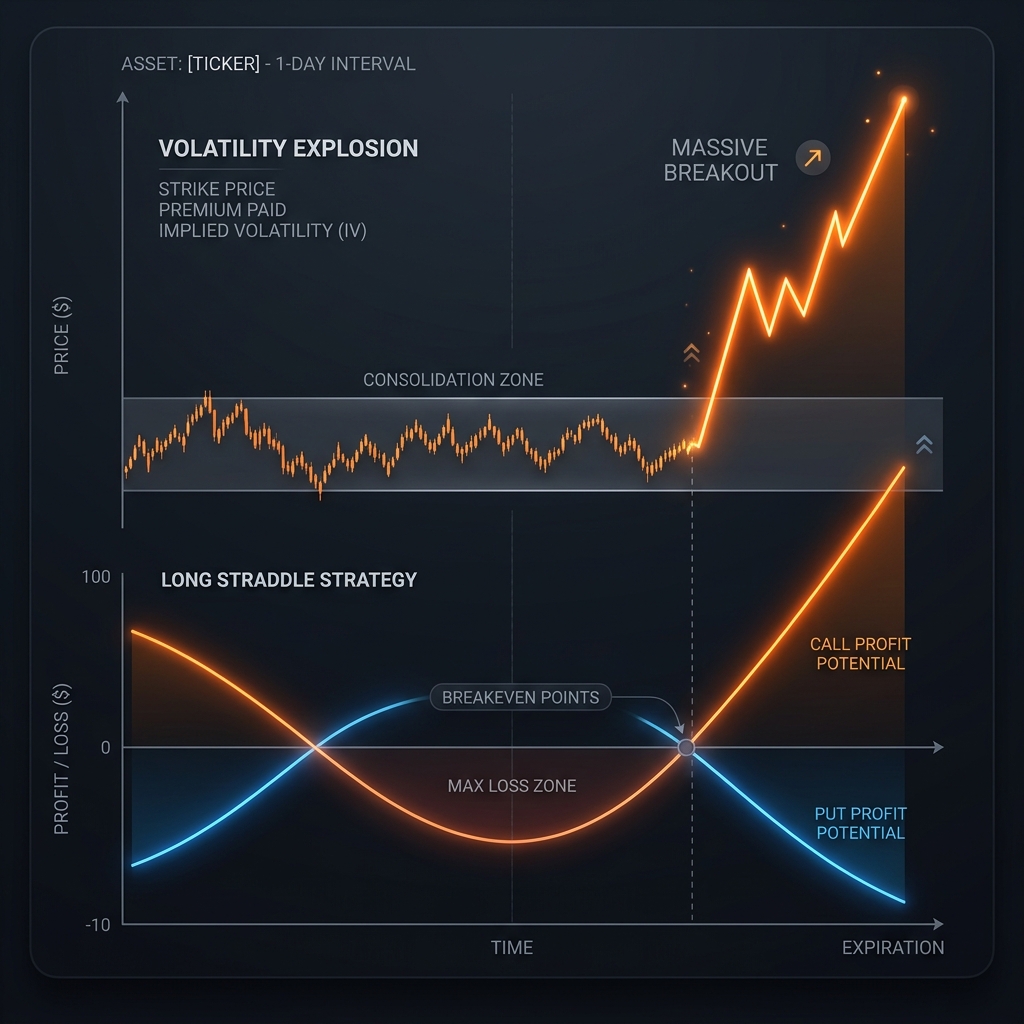
Whether you’re new to zero-days-to-expiration or scaling an existing approach, understanding the fundamentals of 0DTE trading strategy is essential before you trade live capital. This guide covers.
Why Risk Management is the Only Holy Grail
The internet is flooded with “Holy Grail” trading strategies—secret indicators, proprietary algorithmic flow readers, and unbreakable charting patterns.
Here is the brutal truth of 0DTE (Zero Days to Expiration) trading: A mediocre strategy with elite risk management will make you wealthy. A genius strategy with poor risk management will bankrupt you.
In 0DTE trading, the velocity of the market is unmatched. Because options expire at 4:00 PM the exact same day, a single bad trade left unmanaged will result in a total 100% loss of the capital allocated to that trade. If you are selling options (like Credit Spreads), a single unmanaged loss can wipe out three weeks of consistent profits.
Risk management is not a defensive tactic you use when you are scared. It is the offensive framework that allows you to survive the statistical anomalies of the market long enough for your trading edge to play out over a large sample size.
The Four Pillars of 0DTE Risk Control
To survive the 0DTE arena, you must architect your trading business around four unbreakable pillars. If you violate even one of these rules, you are no longer trading; you are gambling.
Pillar 1: The 2% Maximum Risk Rule
This is the foundational law of professional trading. You must mathematically cap your maximum possible loss on any single trade to no more than 1% to 2% of your total account equity.
If you have a $10,000 trading account:
- Your absolute maximum risk per trade is $200.
- If you are buying a 0DTE Call, you cannot spend more than $200 on the premium.
- If you are selling a 5-point wide Credit Spread ($500 max loss), and you collect $100 in premium, your true risk is $400 per contract. You cannot take this trade, because $400 exceeds your 2% ($200) limit. You must widen your account or tighten the spread.
The Math of Ruin: Why 2%? Because losing streaks are a statistical certainty. If you risk 10% per trade and hit a streak of 6 losses, you have lost 60% of your account. Recovering from a 60% drawdown requires a subsequent 150% gain just to break even. If you risk 2% per trade and hit a 6-trade losing streak, you are only down 12%. You live to fight another day.
Pillar 2: The Hard Stop Loss
In swing trading, you might give a stock “room to breathe.” In 0DTE trading, breathing room is a luxury you cannot afford because Theta decay is actively destroying your option’s value.
- For Premium Buyers (Directional Scalping): Set a hard stop at 30% to 50% of the premium paid. If you buy a Put for $300, set an automatic trigger to sell it if its value drops to $150. Do not wait for a bounce.
- For Premium Sellers (Credit Spreads): Set your stop loss at exactly 2x or 3x the premium collected. If you sell a Credit Spread for $100, set a stop order to buy it back (close the trade) if it costs $300. This caps your net loss at $200, preserving your capital and your sanity.
Pillar 3: The Maximum Daily Drawdown
Even with the 2% rule, a trader can easily blow up an account if they take 15 bad trades in a single day. This happens due to “revenge trading”—the psychological compulsion to immediately win back a loss.
To prevent this, you must establish a Max Daily Drawdown (MDD).
- A conservative MDD is 4% of your total account.
- An aggressive MDD is 6% of your total account. If your account drops by this percentage in a single day, you are mathematically required to close all open positions, shut off your computer, and walk away. Your mindset is compromised. The market is not aligning with your edge today. Live to fight tomorrow.
Pillar 4: Take-Profit Mechanics (Don’t Be Greedy)
Greed will kill a 0DTE trader faster than fear. 0DTE options are highly volatile; an option that is up 80% at 11:00 AM can easily expire worthless at 4:00 PM if the market reverses.
- Scale Out: If you buy 3 contracts and they shoot up 50% in value, immediately sell 2 of them to lock in the profit. Leave the final “runner” contract to capture a massive move, but move its stop loss to break-even. The trade is now mathematically risk-free.
- The 75% Rule for Sellers: If you sell a Credit Spread for $100, and by 1:00 PM it has decayed to $25, close the trade. You have captured 75% of the maximum possible profit. Do not risk holding the trade for another 3 hours just to squeeze out the final $25. A sudden afternoon Gamma squeeze could turn your 75% winner into a max-loss loser in minutes. Take the money.
Position Sizing Formula
You should never guess how many contracts to buy or sell. Position sizing is a strict mathematical formula.
For Defined-Risk Spread Sellers:
Max Contracts = (Account Size × Risk %) / (Width of Spread - Premium Collected)
Example: You have a $20,000 account. You want to risk 2% ($400). You want to sell a 5-point wide Credit Spread ($500 max risk per contract). You collect $1.00 ($100) in premium. True Risk per Contract: $500 - $100 = $400. Calculation: $400 / $400 = 1 Contract. You can sell exactly 1 contract.
For Naked Option Buyers:
Max Contracts = (Account Size × Risk %) / (Option Cost × Stop Loss %)
Example: You have a $20,000 account. You risk 2% ($400). A 0DTE Call costs $3.00 ($300). Your strict stop loss is 50%. Risk per Contract: $300 × 50% = $150. Calculation: $400 / $150 = 2.66 Contracts. You must round down. You can buy exactly 2 contracts.
The Psychology of 0DTE Risk
The mechanics of risk management are easy to understand but incredibly difficult to execute because human beings are biologically wired to hate losing.
When a trade goes against a novice trader, their brain views it as a personal failure. They remove their stop loss, hoping the market will turn around so they don’t have to “admit defeat.” When the market doesn’t turn, their account is devastated.
Professional traders do not tie their ego to individual trades. They view trading as a casino views the roulette wheel. The casino knows that on any single spin, the player might win. But the casino also knows that because of the “0” and “00” on the wheel, they have a 5.26% statistical edge. As long as the casino limits the maximum bet size (risk management) and keeps spinning the wheel, they are mathematically guaranteed to make millions of dollars over a large sample size.
When you execute your stop loss perfectly and take a small, 2% hit to your account, you should not feel anger. You should feel immense pride. You just successfully executed the business plan that will keep you in the game long enough to let your mathematical edge make you rich.
Stop Blowing Up Accounts
Learn the institutional risk management frameworks that guarantee long-term survival. Join 01DTE.com to access position sizing calculators, automated stop-loss strategies, and professional mentorship.
Start Trading with 01DTE
To further refine your strategy, consider comparing this approach with the 0DTE vs 1DTE or exploring the mechanics behind 0DTE Options Greeks Explained. Everything ties back into the foundational concepts available in our Education Hub.
If you want to visualize these market forces live, check out the 01DTE dashboard.
Ready to Master Risk Management Fundamentals?
Stop guessing and start executing with precision. Join our community of professional traders and get access to real-time gamma levels, flow analysis, and institutional-grade trading tools.
Start Trading NowFrequently Asked Questions
What is 0DTE Risk Management in the context of 0DTE trading?
Yes, understanding 0DTE Risk Management is critical for day traders. It refers to the specific methodology of managing zero days to expiration positions by leveraging intraday volatility. Traders use this approach to capture rapid premium decay while strictly defining their risk parameters. By utilizing this strategy correctly, you can optimize your entry and exit points throughout the trading session without holding overnight risk.
How does 0DTE Risk Management impact risk management?
The primary risk when using 0DTE Risk Management involves sudden intraday market reversals (gamma risk). Because 0DTE options expire the same day, any adverse movement in the underlying asset can result in rapid, exponential losses if left unmanaged. Strict stop losses, position sizing limits (risking no more than 1% to 2% of account capital), and automated risk controls are absolutely essential to survive over the long term.
Is 0DTE Risk Management suitable for beginner traders?
No, beginners should exercise extreme caution. 0DTE Risk Management requires a deep understanding of options pricing models, Greek dynamics (especially Gamma and Theta), and order execution speed. Novice traders should spend several months paper trading and backtesting their approach before risking live capital, as the emotional and financial swings associated with this strategy can be overwhelming without prior experience.
What is the best time of day to execute 0DTE Risk Management?
Execution timing depends heavily on the specific setup, but many professional traders prefer to enter 0DTE Risk Management trades during the mid-morning session (around 10:30 AM to 11:30 AM EST) after the initial opening volatility has subsided. Others wait for the final two hours of the day (2:00 PM to 4:00 PM EST) to capture the most aggressive phase of theta decay, though this carries elevated directional risk.
Which brokers are best for trading 0DTE Risk Management?
For executing 0DTE Risk Management, you need a broker with direct market access, lightning-fast execution, and favorable commission structures. Interactive Brokers, Tastytrade, and ThinkOrSwim (Charles Schwab) are highly recommended by professionals. These platforms offer robust API integrations, advanced charting tools, and the necessary options permissions (Level 2 or higher) required to trade complex intraday strategies effectively.
Disclaimer: This content is for educational purposes only. Not financial advice. Options trading involves substantial risk. Consult a licensed financial advisor before trading. Full disclaimer
Related Articles
0DTE Vertical Spread Options Trading Strategy | 0DTE Guide
Master the 0DTE Vertical Spread 0DTE trading strategy. Learn risk management, setups, and maximize your win rate today with our comprehensive guide.
0DTE Credit Spread Options Trading Strategy | 0DTE Guide
Master the 0DTE Credit Spread 0DTE trading strategy. Learn risk management, setups, and maximize your win rate today with our comprehensive guide.
0DTE Covered Call Options Trading Strategy | 0DTE Guide
Master the 0DTE covered call — own shares and sell calls for daily income. A conservative strategy for generating returns from existing positions.
0DTE Cash Secured Put Options Trading Strategy | 0DTE Guide
Master the 0DTE Cash Secured Put 0DTE trading strategy. Learn risk management, setups, and maximize your win rate today with our comprehensive guide.
What is 0DTE Trading? The Complete Beginner's Guide
Everything you need to know about 0DTE (Zero Days to Expiration) options trading. Learn the mechanics, the risks, and the strategies used by professionals.