0DTE Strangle Options Trading Strategy | 0DTE Guide
Master the 0DTE Strangle with our comprehensive 0DTE options trading strategy guide. Learn risk management, optimal setups, and maximize your win rate today.
Capital Required: $500-$3,000
The 0DTE Strangle
Capitalize on massive moves with less upfront premium.
Whether you’re new to zero-days-to-expiration or scaling an existing approach, understanding the fundamentals of this 0DTE trading resource is essential before you trade live capital. This guide covers.
The Mechanics of a 0DTE Strangle
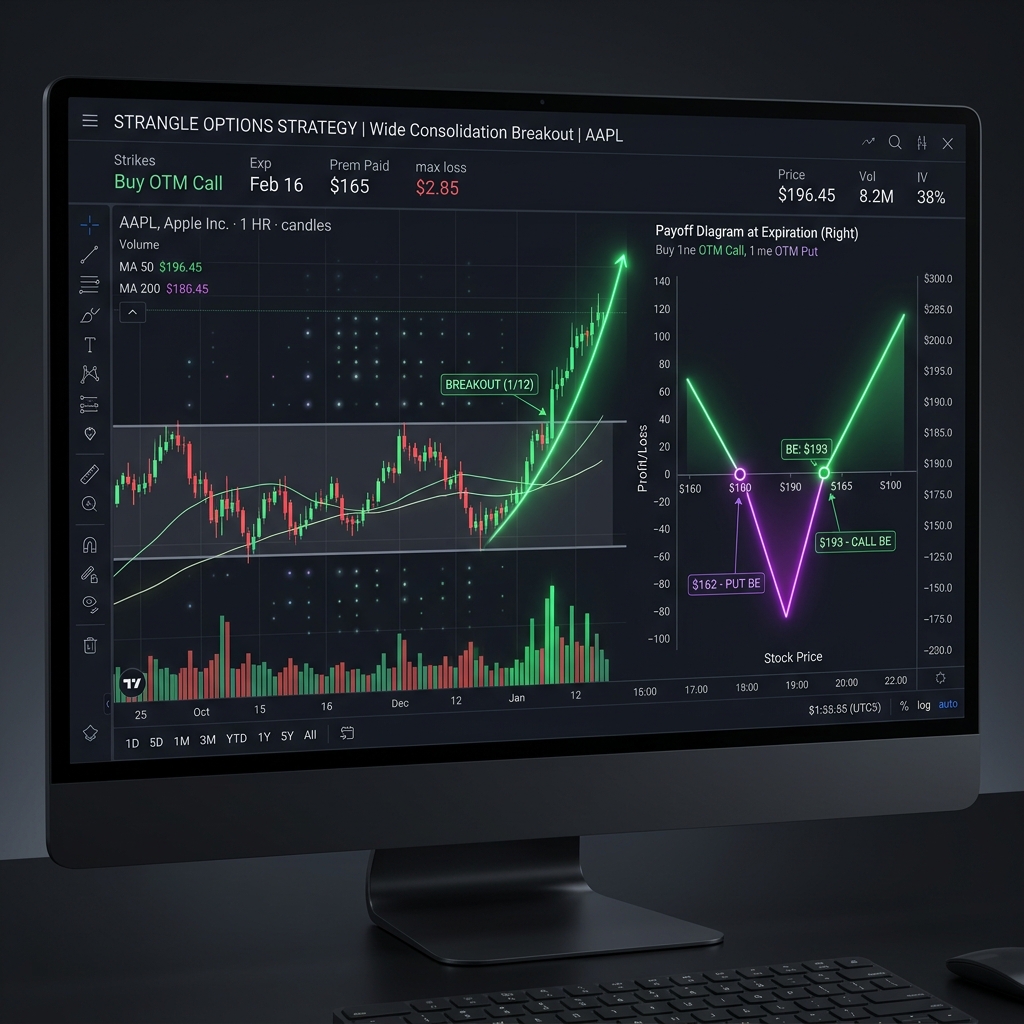
The 0DTE Strangle is a powerful, non-directional volatility strategy. Unlike a straddle—which requires purchasing both a call and a put at the exact same strike price—the strangle involves buying an Out-Of-The-Money (OTM) Call and an Out-Of-The-Money (OTM) Put at different strike prices, both expiring the same day.
Because you are buying OTM options, the initial debit (premium paid) is significantly lower than a straddle. However, this cost efficiency comes with a trade-off: the underlying asset must make a much larger percentage move to overcome the wider breakeven points.
When trading a 0DTE strangle, you don’t care whether the market crashes or skyrockets. Your only requirement is that it moves violently in one direction.
Long Strangle: The Breakout Hunter
The long strangle is favored by traders expecting an outsized move but who want to preserve capital compared to trading ATM options.
- Trade Setup: Buy 1 OTM Call + Buy 1 OTM Put.
- Max Risk: The total premium paid for both options. This is a defined risk strategy. You lose the maximum amount if the underlying asset stays between your two strike prices at expiration.
- Breakeven Points: Upper Strike + Total Premium, and Lower Strike - Total Premium.
- Profit Potential: Theoretically unlimited on the upside and substantial on the downside. The position becomes profitable once the asset surges past either breakeven point.
- Strategic Advantage: It offers a cheaper entry than a straddle, allowing for multiple shots on goal if the first breakout attempt fails.
Short Strangle: The Volatility Seller
The short strangle flips the script. It is employed by traders who believe the market will remain relatively stable, staying bound within a specific range until the closing bell.
- Trade Setup: Sell 1 OTM Call + Sell 1 OTM Put.
- Max Profit: The total premium received upfront. This profit is realized if the underlying asset closes perfectly between the two strike prices.
- Max Risk: Theoretically unlimited on the call side and massive on the put side. This is an extremely high-risk strategy requiring advanced risk management and margin.
- Use Case: Highly effective in choppy, range-bound markets with elevated Implied Volatility that is expected to crush.
Strangle vs. Straddle: Which to Choose?
The decision between a strangle and a straddle boils down to your volatility forecast and budget.
- Cost: Strangles are substantially cheaper. You can often buy a strangle for half the price of a straddle.
- Required Move: Straddles require a smaller move to become profitable. Strangles require a “tail event” or massive momentum shift.
- Theta Decay: Both suffer from aggressive theta decay, but OTM options in a strangle can lose value faster in percentage terms if the underlying doesn’t start moving immediately.
- Rule of Thumb: If you expect a moderate move, buy a straddle. If you expect a historic, violent breakout, buy a strangle to maximize your ROI.
Core Entry Rules and Risk Management
To trade 0DTE strangles successfully, you must adhere strictly to these rules:
Strike Selection (The Delta):
Aim for strikes with a Delta between 15 and 20 on each side. This provides the best balance between premium cost and the probability of moving In-The-Money (ITM).
Width of the Strikes:
Ensure there is adequate width between your strikes, but don’t go too wide. If the strikes are 100 points apart on the SPX, the probability of reaching them in one day is mathematically tiny.
Profit Targets:
For long strangles, target a 50% to 100% net return on the premium paid. Do not hold out for a 1000% lottery ticket. When momentum slows, take the money.
Stop Losses:
Implement a strict stop loss at 50% of the premium paid. Since you are buying OTM options, they will decay to zero very fast if the market chops sideways.
Time Mechanics:
Enter the trade immediately preceding a known catalyst (like economic data or a major technical breakdown). If the expected move does not happen by 3:00 PM EST, close the trade. Do not hold into the final hour hoping for a miracle.
Trade the Breakout with Precision
Stop getting chopped up in range-bound markets. Join 01DTE.com to access real-time volatility alerts, institutional order flow analysis, and a community of elite 0DTE traders.
Start Trading with 01DTE
To further refine your strategy, consider comparing this approach with the 0DTE Calendar Spread or exploring the mechanics behind 0DTE Iron Butterfly Strategy: The Ultimate Guide. Everything ties back into the foundational concepts available in our 0DTE Strategies Hub.
For real-time confirmation of these structures, many professional traders use the 01DTE dashboard to track institutional positioning.
Frequently Asked Questions
What is 0DTE Strangle in the context of 0DTE trading?
Yes, understanding 0DTE Strangle is critical for day traders. It refers to the specific methodology of managing zero days to expiration positions by leveraging intraday volatility. Traders use this approach to capture rapid premium decay while strictly defining their risk parameters. By utilizing this strategy correctly, you can optimize your entry and exit points throughout the trading session without holding overnight risk.
How does 0DTE Strangle impact risk management?
The primary risk when using 0DTE Strangle involves sudden intraday market reversals (gamma risk). Because 0DTE options expire the same day, any adverse movement in the underlying asset can result in rapid, exponential losses if left unmanaged. Strict stop losses, position sizing limits (risking no more than 1% to 2% of account capital), and automated risk controls are absolutely essential to survive over the long term.
Is 0DTE Strangle suitable for beginner traders?
No, beginners should exercise extreme caution. 0DTE Strangle requires a deep understanding of options pricing models, Greek dynamics (especially Gamma and Theta), and order execution speed. Novice traders should spend several months paper trading and backtesting their approach before risking live capital, as the emotional and financial swings associated with this strategy can be overwhelming without prior experience.
What is the best time of day to execute 0DTE Strangle?
Execution timing depends heavily on the specific setup, but many professional traders prefer to enter 0DTE Strangle trades during the mid-morning session (around 10:30 AM to 11:30 AM EST) after the initial opening volatility has subsided. Others wait for the final two hours of the day (2:00 PM to 4:00 PM EST) to capture the most aggressive phase of theta decay, though this carries elevated directional risk.
Which brokers are best for trading 0DTE Strangle?
For executing 0DTE Strangle, you need a broker with direct market access, lightning-fast execution, and favorable commission structures. Interactive Brokers, Tastytrade, and ThinkOrSwim (Charles Schwab) are highly recommended by professionals. These platforms offer robust API integrations, advanced charting tools, and the necessary options permissions (Level 2 or higher) required to trade complex intraday strategies effectively.
Disclaimer: This content is for educational purposes only. Not financial advice. Options trading involves substantial risk. Consult a licensed financial advisor before trading. Full disclaimer
Related Articles
0DTE Straddle Options Trading Strategy | 0DTE Guide
Master the 0DTE Straddle with our comprehensive 0DTE options trading strategy guide. Learn risk management, optimal setups, and maximize your win rate today.
0DTE Butterfly Spread Options Trading Strategy | 0DTE Guide
Master the 0DTE Butterfly Spread 0DTE trading strategy. Learn risk management, setups, and maximize your win rate today with our comprehensive guide.
0DTE Vertical Spread Options Trading Strategy | 0DTE Guide
Master the 0DTE Vertical Spread 0DTE trading strategy. Learn risk management, setups, and maximize your win rate today with our comprehensive guide.
0DTE Ratio Spread Options Trading Strategy | 0DTE Guide
Master the 0DTE Ratio Spread 0DTE trading strategy. Learn risk management, setups, and maximize your win rate today with our comprehensive guide.
0DTE Diagonal Spread Options Trading Strategy | 0DTE Guide
Master the 0DTE Diagonal Spread 0DTE trading strategy. Learn risk management, setups, and maximize your win rate today with our comprehensive guide.