0DTE Calendar Spread Options Trading Strategy | 0DTE Guide
Master the 0DTE Calendar Spread 0DTE trading strategy. Learn risk management, setups, and maximize your win rate today with our comprehensive guide.
Capital Required: $500-$2,000
The Calendar Spread
Harnessing the power of multi-timeframe theta decay.
Whether you’re new to zero-days-to-expiration or scaling an existing approach, understanding the fundamentals of zero days to expiration trading is essential before you trade live capital. This guide covers.
The Mechanics of a 0DTE Calendar Spread
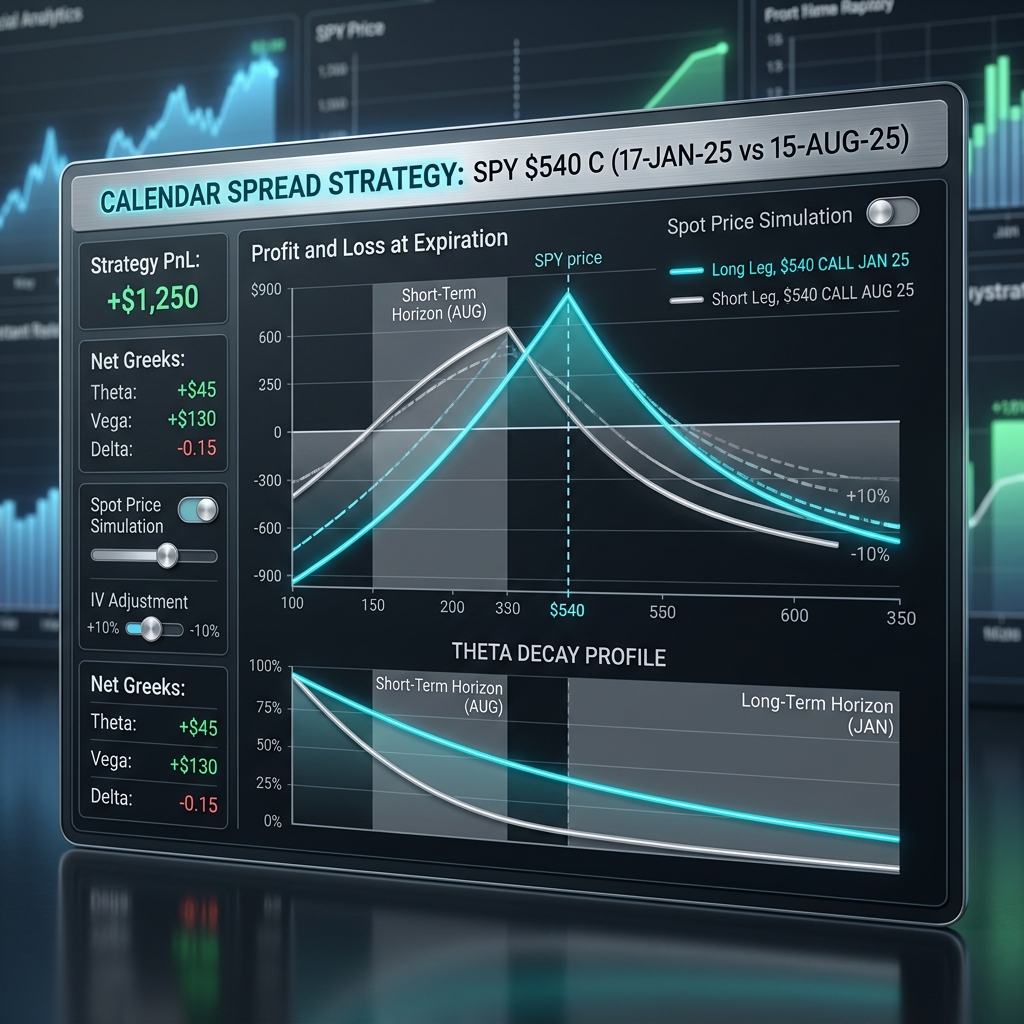
The 0DTE Calendar Spread (also known as a time spread or horizontal spread) is a highly nuanced strategy that attempts to profit from the passage of time and changes in implied volatility, rather than directional price movement. This is achieved by entering two options positions at the exact same strike price but with different expiration dates.
In a standard 0DTE Calendar setup, you are selling an option that expires today, while simultaneously buying an option that expires in the future (e.g., the next day, or next week). The goal is to isolate and exploit the exponential theta decay that occurs on the final day of an option’s lifecycle.
The Structural Setup
To initiate a 0DTE Calendar Spread, you execute the following:
- The Short Leg: Sell 1 At-The-Money (ATM) Option (Call or Put) expiring today (0DTE).
- The Long Leg: Buy 1 At-The-Money (ATM) Option (Call or Put) at the exact same strike price, expiring at a later date.
Because longer-term options are inherently more expensive than shorter-term options, entering a calendar spread will always cost you money upfront (a net debit).
How the Calendar Makes Money
The primary driver of profitability in a calendar spread is the difference in Theta (time decay) between the two options. Option decay is not linear; it accelerates rapidly as expiration approaches.
Therefore, your short 0DTE option will lose value much faster than your long, later-dated option. If the underlying asset remains near your strike price, the short option expires worthless (or nearly worthless), allowing you to keep the premium you collected. Meanwhile, your long option retains most of its value, which you can then sell back to the market for a net profit.
Additionally, calendar spreads are long Vega trades. This means they benefit from an increase in overall market implied volatility, as the longer-dated option is more sensitive to IV changes than the expiring option.
When to Deploy the Calendar Spread
Anticipating Consolidation:
The absolute best time to deploy a calendar spread is when you expect the market to chop sideways and “pin” near your chosen strike price for the day.
Before Volatility Expansion:
If you believe the market is quiet now but volatility will expand after today’s close, a calendar spread allows you to collect today’s theta while holding a long-volatility position for tomorrow.
Earnings or Event Preparation:
Entering a calendar spread in the days leading up to a major event can capture rising IV in the back-month option while the front-month option decays harmlessly.
Essential Entry Rules and Risk Management
To trade 0DTE calendar spreads successfully, strict adherence to these parameters is required:
Strike Selection:
Typically, you want to choose the ATM strike price to maximize the extrinsic value you are selling on the 0DTE leg.
Term Structure Check:
Before entering, verify that the implied volatility of the near-term option is higher than or equal to the longer-term option. If the back-month is significantly more expensive in terms of IV, you are overpaying.
Strict Stop Losses:
Calendar spreads can lose money rapidly if the market makes a sharp, sustained directional move. If the underlying asset blows past your strike price, the long option will not gain enough intrinsic value to offset the losses on the short option. Set a hard stop at a 30% to 50% loss of the initial debit paid.
Profit Taking:
Do not be greedy. The “tent” of profitability on a calendar spread is narrow. If you achieve a 30% to 50% return on your initial debit, close the entire spread.
Closing the Position:
Always close both legs of the spread simultaneously. Do not attempt to “leg out” by closing the short option and holding the long option naked, as this dramatically shifts your risk profile into a purely directional bet.
Master Multi-Timeframe Trading
Stop getting chopped up in range-bound markets. Join 01DTE.com to access advanced volatility term structure analytics, real-time alerts, and a community of elite options traders.
Start Trading with 01DTE
To further refine your strategy, consider comparing this approach with the 0DTE Iron Condor Strategy for Futures or exploring the mechanics behind 0DTE Ratio Spread. Everything ties back into the foundational concepts available in our 0DTE Strategies Hub.
Rather than guessing the market direction, you can use the 01DTE dashboard to see exactly where market makers are hedged.
Frequently Asked Questions
What is 0DTE Calendar Spread in the context of 0DTE trading?
Yes, understanding 0DTE Calendar Spread is critical for day traders. It refers to the specific methodology of managing zero days to expiration positions by leveraging intraday volatility. Traders use this approach to capture rapid premium decay while strictly defining their risk parameters. By utilizing this strategy correctly, you can optimize your entry and exit points throughout the trading session without holding overnight risk.
How does 0DTE Calendar Spread impact risk management?
The primary risk when using 0DTE Calendar Spread involves sudden intraday market reversals (gamma risk). Because 0DTE options expire the same day, any adverse movement in the underlying asset can result in rapid, exponential losses if left unmanaged. Strict stop losses, position sizing limits (risking no more than 1% to 2% of account capital), and automated risk controls are absolutely essential to survive over the long term.
Is 0DTE Calendar Spread suitable for beginner traders?
No, beginners should exercise extreme caution. 0DTE Calendar Spread requires a deep understanding of options pricing models, Greek dynamics (especially Gamma and Theta), and order execution speed. Novice traders should spend several months paper trading and backtesting their approach before risking live capital, as the emotional and financial swings associated with this strategy can be overwhelming without prior experience.
What is the best time of day to execute 0DTE Calendar Spread?
Execution timing depends heavily on the specific setup, but many professional traders prefer to enter 0DTE Calendar Spread trades during the mid-morning session (around 10:30 AM to 11:30 AM EST) after the initial opening volatility has subsided. Others wait for the final two hours of the day (2:00 PM to 4:00 PM EST) to capture the most aggressive phase of theta decay, though this carries elevated directional risk.
Which brokers are best for trading 0DTE Calendar Spread?
For executing 0DTE Calendar Spread, you need a broker with direct market access, lightning-fast execution, and favorable commission structures. Interactive Brokers, Tastytrade, and ThinkOrSwim (Charles Schwab) are highly recommended by professionals. These platforms offer robust API integrations, advanced charting tools, and the necessary options permissions (Level 2 or higher) required to trade complex intraday strategies effectively.
Disclaimer: This content is for educational purposes only. Not financial advice. Options trading involves substantial risk. Consult a licensed financial advisor before trading. Full disclaimer
Related Articles
0DTE Iron Butterfly Options Trading Strategy | 0DTE Guide
Master the iron butterfly 0dte strategy. Learn how to maximize income, manage gamma risk, and execute the 0dte spx iron butterfly strategy effectively.
0DTE Diagonal Spread Options Trading Strategy | 0DTE Guide
Master the 0DTE Diagonal Spread 0DTE trading strategy. Learn risk management, setups, and maximize your win rate today with our comprehensive guide.
0DTE Credit Spread Options Trading Strategy | 0DTE Guide
Master the 0DTE Credit Spread 0DTE trading strategy. Learn risk management, setups, and maximize your win rate today with our comprehensive guide.
0DTE Covered Call Options Trading Strategy | 0DTE Guide
Master the 0DTE covered call — own shares and sell calls for daily income. A conservative strategy for generating returns from existing positions.
0DTE Butterfly Spread Options Trading Strategy | 0DTE Guide
Master the 0DTE Butterfly Spread 0DTE trading strategy. Learn risk management, setups, and maximize your win rate today with our comprehensive guide.