0DTE Straddle Options Trading Strategy | 0DTE Guide
Master the 0DTE Straddle with our comprehensive 0DTE options trading strategy guide. Learn risk management, optimal setups, and maximize your win rate today.
Capital Required: $1,000-$5,000
Capture the Breakout
Profit from massive directional moves using the 0DTE straddle.
Whether you’re new to zero-days-to-expiration or scaling an existing approach, understanding the fundamentals of 0DTE trading is essential before you trade live capital. This guide covers.
The Ultimate Volatility Play: Understanding the 0DTE Straddle
If you have spent any time in the fast-paced world of zero-days-to-expiration trading, you have likely heard traders bragging about massive triple-digit returns captured in a matter of minutes. More often than not, these explosive gains are the result of a perfectly timed 0dte straddle.
But before you risk your capital, you must understand exactly how this double-edged sword operates. This comprehensive, 2,500-word guide will serve as your masterclass. We will break down exactly what is straddle strategy, explore the mathematical nuances of when to use straddle strategy, answer the critical question of is straddle a good strategy for your specific risk tolerance, and deeply analyze the difference between strangle and straddle strategy mechanics.
By the end of this guide, you will have moved past the gambling mentality often seen when discussing 0dte straddles reddit threads, and you will understand how to execute this strategy like an institutional volatility trader on the ES futures and SPX options chains.
Part 1: What is Straddle Strategy?
To answer the fundamental question of what is straddle strategy, we must look at its core mechanics. A straddle is a delta-neutral options strategy designed specifically to capture explosive volatility. It involves simultaneously transacting (buying or selling) both a Call option and a Put option at the exact same At-The-Money (ATM) strike price, with the exact same expiration date.
Because both contracts expire on the same day (0DTE), this strategy is not about long-term forecasting or fundamental analysis; it is entirely about predicting an imminent, massive directional price expansion without needing to guess which direction the market will break.
When you purchase a 0dte straddle, you are essentially buying pure volatility. You are betting that the underlying asset (such as the S&P 500) will experience a violent price swing that mathematically outweighs the combined cost of the premiums paid for both the call and the put.
The Mechanics of the Long Straddle
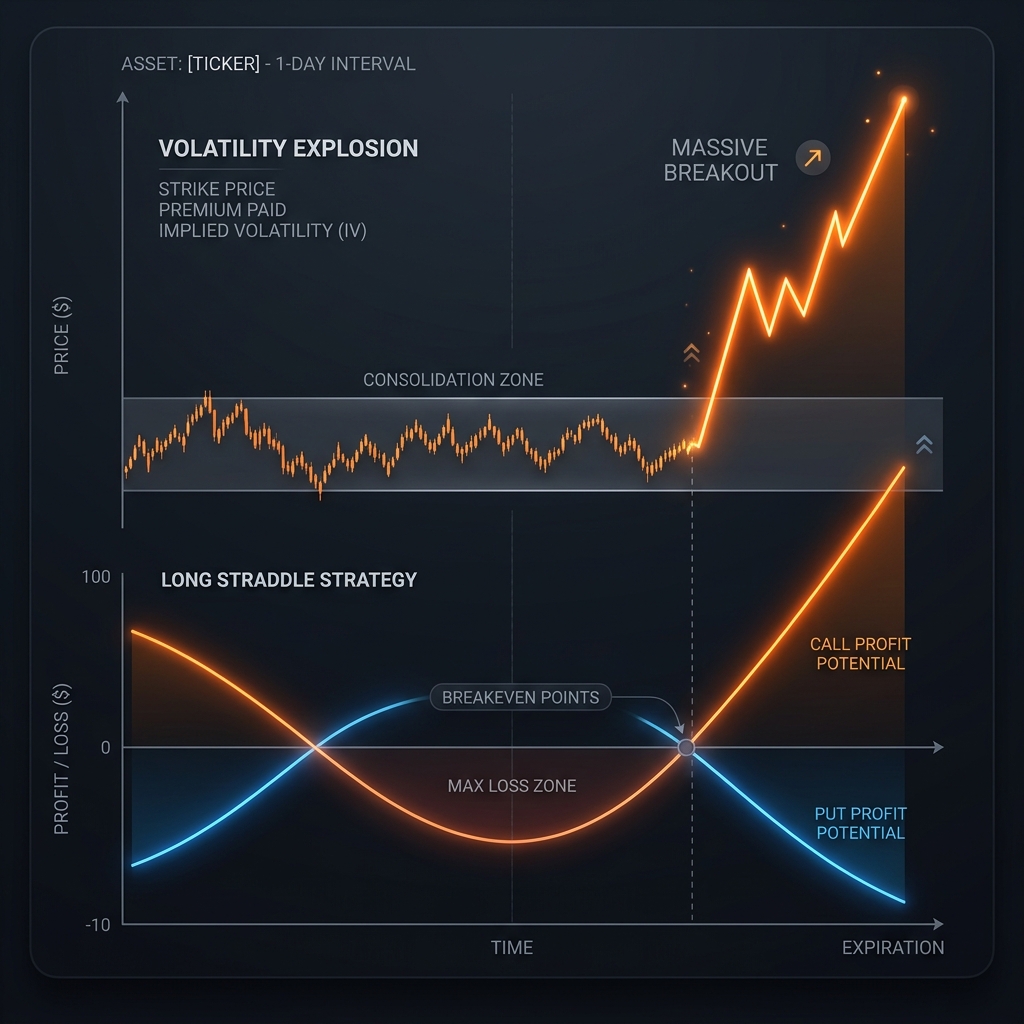
The long straddle is the weapon of choice for breakout traders. You want the market to break its tight intraday range violently.
- Trade Setup: Buy 1 ATM Call + Buy 1 ATM Put.
- Max Risk: The total premium paid for both options. This absolute maximum loss only occurs if the market pins exactly at your selected strike price at the end of the day (4:00 PM EST).
- Breakeven Points: The ATM Strike ± the total premium paid. For example, if the ES is at 4100 and you pay 10 points for the call and 10 points for the put (20 points total), your breakevens are 4120 and 4080. The market must move past these points for the trade to be profitable at expiration.
- Profit Potential: Theoretically unlimited in either direction. The further the market runs, the more the profitable leg’s intrinsic value and gamma acceleration compensate for the losing leg’s rapid decay.
The Mechanics of the Short Straddle
The short straddle is for days when you expect market exhaustion, low volume, or tight consolidation. You are acting as the casino, collecting premium from retail traders expecting a breakout that never arrives.
- Trade Setup: Sell 1 ATM Call + Sell 1 ATM Put.
- Max Profit: The total premium received upfront. You keep 100% of this credit only if the market pins exactly at the strike price at expiration.
- Max Risk: Theoretically unlimited on the upside, and substantial on the downside. This is a high-risk trade requiring strict, automated stop losses.
- Breakeven Points: The ATM Strike ± the total premium received.
Part 2: When to Use Straddle Strategy
Knowing what is straddle strategy is only the first step. The true alpha lies in knowing exactly when to use straddle strategy. Timing is absolutely everything with 0DTE options because of the aggressive, exponential theta (time decay). Entering a straddle at the wrong time of day, or in the wrong volatility regime, guarantees a 100% loss of premium.
1. Macroeconomic Catalyst Days
The most popular time to deploy a long 0dte straddle is immediately prior to massive tier-1 economic data releases or Federal Reserve events.
- FOMC Rate Decisions and Press Conferences: At 2:00 PM EST on FOMC days, the market often reprices violently. Buying a straddle at 1:55 PM allows you to capture the sheer velocity of the move, regardless of whether the Fed is deemed hawkish or dovish.
- CPI and NFP Data: Because these are released at 8:30 AM EST (before the cash market opens), traders use 0DTE options on ES futures to capture the pre-market volatility explosion.
Warning: Implied Volatility (IV) expands significantly before these events. You must ensure the expected move is not already fully priced into the premium, otherwise you will suffer from “IV Crush” immediately after the announcement, turning a winning directional move into a losing trade.
2. Technical Breakout Setups (Gamma Walls)
Look for tight consolidation patterns (bull flags, pennants, wedges) on the 5-minute or 15-minute charts that are pinned right against a major institutional “Gamma Wall” (a strike with massive open interest). When price compresses in these zones for hours, energy builds up. When the level finally breaks, dealer hedging algorithms are forced to cover their positions rapidly, triggering a violent expansion. This is the optimal environment for a long straddle.
3. The 0DTE Power Hour (3:00 PM - 4:00 PM EST)
Late-day institutional rebalancing can cause rapid trend shifts. Gamma is at its absolute peak during the final 60 minutes of the trading day. A 10-point move in the ES futures at 11:00 AM might slightly increase your straddle’s value. The exact same 10-point move at 3:45 PM can cause the winning leg of your straddle to explode by 300% to 500% in minutes.
Part 3: Is Straddle a Good Strategy?
A frequently asked question among developing traders is: is straddle a good strategy for consistent daily income?
The honest, professional answer is: It depends entirely on your discipline and market selection.
The Pros of the 0DTE Straddle
- Directional Agnosticism: You do not need to be a macro-economist or a technical analysis wizard. If you know a massive move is coming, but you don’t know which way, the straddle removes the directional guesswork.
- Asymmetric Risk-to-Reward (Long Straddle): Your risk is strictly defined (the premium paid), while your upside potential is theoretically limitless if a true black swan or massive trend day occurs.
- Gamma Acceleration: Because you are buying ATM options, your delta will rapidly increase toward 1.00 (or -1.00) in the direction of the move, meaning your profits accelerate the further the market runs.
The Cons and Dangers
- The Theta Bleed: 0DTE options decay at a terrifying rate. If the market chops sideways for even 45 minutes after you buy a straddle, theta decay will erode 30% to 50% of your premium. You are constantly fighting the clock.
- The Cost of Premium (Double Whipsaw): Because you are buying both a call and a put, straddles are expensive. If the market moves up, hits resistance, and then crashes back down to your strike price, you will lose money on both sides of the trade.
- The Short Straddle Risk: For premium sellers, the short straddle offers excellent income on flat days, but exposes the account to catastrophic margin calls and infinite risk on trend days. It is not recommended for beginners.
So, is straddle a good strategy? Yes, but only as a tactical, sniper-like tool used sparingly during specific volatility regimes. It is not a strategy you can blindly deploy every single morning at 9:30 AM.
Part 4: Difference Between Strangle and Straddle Strategy
Novice traders frequently confuse the straddle with its close cousin, the strangle. Understanding the difference between strangle and straddle strategy is critical for capital allocation and probability modeling.
The Core Distinction: Strike Selection
- The Straddle: Involves buying a Call and a Put at the exact same At-The-Money (ATM) strike.
- The Strangle: Involves buying a Call and a Put at different Out-of-The-Money (OTM) strikes.
Cost vs. Probability
The primary difference between strangle and straddle strategy revolves around the cost of entry and the magnitude of the move required to achieve profitability.
- The Cost (Premium Paid): Because a straddle uses ATM options (which possess the highest extrinsic value), it is very expensive to enter. A strangle uses OTM options, which are significantly cheaper. You can often buy a strangle for half the price of a straddle.
- The Required Move (Breakeven): While the strangle is cheaper, it requires a much larger directional move to become profitable. The market must first move through your OTM strike just to build intrinsic value, and then continue moving to overcome the premium paid. The straddle, being already ATM, begins building intrinsic value the moment the market moves one tick in either direction.
- Gamma Sensitivity: The straddle is highly sensitive to immediate price movements because its options are at the money (Gamma is highest at the ATM strike). The strangle will lag until the underlying price approaches one of the OTM wings.
Which should you choose? If you expect a massive, historic outlier move (e.g., a surprise CPI print), the cheaper Strangle offers incredible Return on Capital. If you expect a strong but normal directional breakout, the Straddle is vastly superior because it responds to price action immediately.
Part 5: 0DTE Straddles Reddit — Separating Myth from Reality
If you browse financial social media, particularly threads discussing 0dte straddles reddit, you will find a highly polarized community. WallStreetBets and similar forums are littered with screenshots of traders turning $1,000 into $20,000 in a single afternoon using 0DTE straddles, alongside equally common posts of traders losing their entire life savings.
The Reddit Mindset vs. The Professional Mindset
The retail consensus on 0dte straddles reddit often treats the strategy like a lottery ticket. Retail traders will blindly buy straddles at the market open, hoping for a trend day, and then hold the position until 4:00 PM. This “diamond hands” approach to 0DTE trading is mathematically guaranteed to destroy an account over a long enough timeline due to theta decay.
What the Professionals Actually Do
Institutional traders and professional proprietary firms do not treat the 0DTE straddle as a lottery ticket. They use it as a highly calculated structural arbitrage tool.
- Gamma Scalping: Professionals will buy an ATM straddle, and as the market moves directionally, they will buy or sell the underlying ES futures to continuously neutralize their delta. This allows them to lock in profits from the gamma expansion while paying for the theta decay. This requires sophisticated algorithms and is entirely absent from retail Reddit discussions.
- Strict Time Stops: Professionals rarely hold a 0DTE straddle for more than 45 to 60 minutes. If the anticipated volatility expansion does not occur within their strictly defined time window, they cut the position for a 20% loss rather than watching it bleed to a 100% loss at the closing bell.
Part 6: Strict Execution Rules for the Long Straddle
To survive and thrive trading 0DTE straddles on futures, you must execute with robotic precision. Throw away the gambling mindset and memorize these five institutional rules:
Strike Selection:
Always choose the absolute At-The-Money (ATM) strike based on the current underlying futures price. This gives you the highest Gamma exposure, allowing your delta to rapidly accelerate toward 1.00 when the breakout begins.
Volatility Check:
Do not buy straddles when Implied Volatility (IV) is already historically high for the day (e.g., VIX > 25). You will severely overpay for the premium, making it mathematically nearly impossible for the underlying move to overcome the cost basis and hit your breakeven points.
Aggressive Profit Targets:
Be extremely aggressive with taking profits. Aim for a 40% to 80% net gain on the total position. Once you see a sharp, high-volume price spike in one direction, immediately sell the winning leg to lock in gains, or close the entire straddle outright.
Hard Stop Loss Mechanics:
Set a hard mental or platform stop loss at a 35% to 40% drawdown of the total premium paid. If the market chops sideways and theta begins destroying your premium, cut the trade. Do not pray for a late-day reversal miracle.
Ruthless Time Stops:
If the anticipated breakout move hasn’t materialized by 2:30 PM EST, close the position immediately. The hyper-accelerated theta decay in the final 90 minutes of the session will completely decimate your premium, even if a small directional move eventually occurs.
Part 7: Advanced Trade Management and Sizing
Position sizing is the only holy grail in trading. Because the long 0DTE straddle is a low-probability, high-reward trade (win rates often hover around 35% to 40%), you will experience losing streaks.
If you are risking 10% of your account on a single straddle, a three-day chop market will destroy 30% of your net worth. Professional Rule: Never risk more than 1% to 2% of your total account capital on a single straddle position. If your account is $25,000, your maximum risk (total premium paid for the straddle) should not exceed $250 to $500.
The Leg-Out Strategy
When a massive directional move occurs, one leg of your straddle will skyrocket in value while the other leg drops to near-zero. Advanced traders utilize a “leg-out” strategy:
- The market rips higher. Your Call option is up 200%. Your Put option is down 90%.
- You sell the Call option to lock in the massive profit.
- You leave the nearly worthless Put option open.
- If the market suddenly reverses and crashes back down (a common occurrence in high-volatility regimes), that Put option can unexpectedly revive from the dead and pay out a secondary profit. Since it was already down 90%, the remaining risk was negligible.
Part 8: Summary and Conclusion
The 0DTE straddle is not a beginner’s toy. It is a highly specialized volatility instrument that requires deep understanding of options pricing, greek mechanics, and strict emotional discipline.
By understanding what is straddle strategy, pinpointing exactly when to use straddle strategy around key technical or macroeconomic catalysts, and respecting the critical difference between strangle and straddle strategy pricing, you can elevate your trading from retail gambling to institutional execution.
Remember, the goal is not to trade a straddle every day. The goal is to stalk the market, wait patiently for volatility compression and imminent catalysts, and strike with precision when the odds are heavily skewed in your favor.
To further refine your strategy, consider comparing this approach with the 0DTE Credit Spread Strategy or exploring the mechanics behind 0DTE Covered Call. Everything ties back into the foundational concepts available in our 0DTE Strategies Hub.
For real-time confirmation of these structures, many professional traders use the 01DTE dashboard to track institutional positioning.
Ready to Master 0DTE Straddles?
Stop guessing market direction. Join our community of professional futures traders to access real-time breakout alerts, institutional order flow analysis, and live gamma exposure dashboards.
Start Trading NowFrequently Asked Questions
What is 0DTE Straddle in the context of 0DTE trading?
Yes, understanding 0DTE Straddle is critical for day traders. It refers to the specific methodology of managing zero days to expiration positions by leveraging intraday volatility. Traders use this approach to capture rapid premium decay while strictly defining their risk parameters. By utilizing this strategy correctly, you can optimize your entry and exit points throughout the trading session without holding overnight risk.
How does 0DTE Straddle impact risk management?
The primary risk when using 0DTE Straddle involves sudden intraday market reversals (gamma risk). Because 0DTE options expire the same day, any adverse movement in the underlying asset can result in rapid, exponential losses if left unmanaged. Strict stop losses, position sizing limits (risking no more than 1% to 2% of account capital), and automated risk controls are absolutely essential to survive over the long term.
Is 0DTE Straddle suitable for beginner traders?
No, beginners should exercise extreme caution. 0DTE Straddle requires a deep understanding of options pricing models, Greek dynamics (especially Gamma and Theta), and order execution speed. Novice traders should spend several months paper trading and backtesting their approach before risking live capital, as the emotional and financial swings associated with this strategy can be overwhelming without prior experience.
What is the best time of day to execute 0DTE Straddle?
Execution timing depends heavily on the specific setup, but many professional traders prefer to enter 0DTE Straddle trades during the mid-morning session (around 10:30 AM to 11:30 AM EST) after the initial opening volatility has subsided. Others wait for the final two hours of the day (2:00 PM to 4:00 PM EST) to capture the most aggressive phase of theta decay, though this carries elevated directional risk.
Which brokers are best for trading 0DTE Straddle?
For executing 0DTE Straddle, you need a broker with direct market access, lightning-fast execution, and favorable commission structures. Interactive Brokers, Tastytrade, and ThinkOrSwim (Charles Schwab) are highly recommended by professionals. These platforms offer robust API integrations, advanced charting tools, and the necessary options permissions (Level 2 or higher) required to trade complex intraday strategies effectively.
Disclaimer: This content is for educational purposes only. Not financial advice. Options trading involves substantial risk. Consult a licensed financial advisor before trading. Full disclaimer
Related Articles
0DTE Strangle Options Trading Strategy | 0DTE Guide
Master the 0DTE Strangle with our comprehensive 0DTE options trading strategy guide. Learn risk management, optimal setups, and maximize your win rate today.
0DTE Credit Spread Options Trading Strategy | 0DTE Guide
Master the 0DTE Credit Spread 0DTE trading strategy. Learn risk management, setups, and maximize your win rate today with our comprehensive guide.
0DTE Butterfly Spread Options Trading Strategy | 0DTE Guide
Master the 0DTE Butterfly Spread 0DTE trading strategy. Learn risk management, setups, and maximize your win rate today with our comprehensive guide.
0DTE Vertical Spread Options Trading Strategy | 0DTE Guide
Master the 0DTE Vertical Spread 0DTE trading strategy. Learn risk management, setups, and maximize your win rate today with our comprehensive guide.
0DTE Ratio Spread Options Trading Strategy | 0DTE Guide
Master the 0DTE Ratio Spread 0DTE trading strategy. Learn risk management, setups, and maximize your win rate today with our comprehensive guide.